
The Happy Horse Hub presents 1.1 as the current default for a new integration, but it should not receive production traffic until the deployed route proves that it invokes the 1.1 upstream model. The public catalog lists 1.1 as available and starts its API price at $0.24 per second. A version-aware release candidate has passed its focused and related routing tests, but it has not yet been deployed or confirmed with a paid generation.
That distinction changes the honest answer to “which version should I use?” Choose 1.1 as the migration destination, but keep 1.0 as the known baseline until the production acceptance checks in this guide pass. This article compares interfaces, prices, and deployment evidence. It does not present a visual-quality benchmark because no controlled, independently verified 1.1 production run was performed.

This is a Codex editorial illustration, not output from Happy Horse 1.0 or 1.1. It must not be used as evidence of model quality.
Research and review: PixMind Editorial Team. Product, price, and availability evidence was retrieved on September 6, 2026.
For broader model selection, see the 2026 AI video generator comparison. For the current product entry point, use the Happy Horse video hub.
Key Takeaways
- The public API catalog marks
happyhorse-1.1available at a starting price of $0.24 per second. The current 1.0 model page rounds its starting price to $0.19 per second, while its detailed public documentation lists $0.176.- The current connected route exposes text-to-video and single-starting-image generation at 720p or 1080p, with 5, 10, or 15-second durations and five aspect ratios.
- Alibaba documents a wider upstream 1.1 family, including 480p, audio, and reference-to-video modes. Those features must not be described as connected features until the product route exposes and verifies them.
- The focused 9-test route suite passed on September 6. Run together with the related model-directory suite, the combined result was 21 of 21; production 1.1 remains unverified until deployment and a paid acceptance task.
- API dollar pricing and Studio credits are separate systems. The quote returned when a task is accepted is the final transaction-specific cost.
In this guide
- Happy Horse 1.1 vs 1.0 at a glance
- What is verified today
- Upstream and connected capabilities
- API price comparison
- Which version to choose
- Migration checklist
- Commercial-use rights
- Frequently asked questions
Happy Horse 1.1 vs 1.0 at a glance
Happy Horse 1.1 has the stronger upstream specification, while the connected interface is currently much narrower and mostly matches 1.0's exposed controls. The practical difference is therefore not just a version number. It is whether the deployed request reaches the intended upstream model and returns an auditable task record.
| Decision factor | Happy Horse 1.1 | Happy Horse 1.0 | Practical meaning |
|---|---|---|---|
| Stable product model ID | happyhorse-1.1 |
happyhorse-1.0 |
Send an exact ID and record it with the task |
| Public status checked 2026-09-06 | Available | Available in the adjacent model table | Public status is a discovery signal, not execution proof |
| Public API starting price | $0.24/sec | $0.19/sec on the current model page; detailed docs list $0.176 | 1.1 costs more at its starting tier |
| Connected input | Text or one starting image | Text or one starting image | Do not send multiple references to the current route |
| Connected duration presets | 5, 10, 15 seconds | 5, 10, 15 seconds | Revalidate stored presets, even when they appear unchanged |
| Connected resolution | 720p, 1080p | 720p, 1080p | Upstream 480p is not confirmed on the connected 1.1 route |
| Connected aspect ratios | 16:9, 9:16, 1:1, 4:3, 3:4 | 16:9, 9:16, 1:1, 4:3, 3:4 | Existing layout validation can be reused after retesting |
| Connected audio control | Not exposed | Not exposed | Do not promise native audio on this route |
| Connected multi-reference control | Not exposed | Not exposed | Alibaba R2V features are upstream-only here |
| Independent production execution | Not yet verified | Existing baseline | Deploy and run a paid acceptance task before switching |
The Happy Horse 1.1 API page is the current public reference for status, model ID, builder controls, and starting price. Its linked full 1.1 documentation route returned 404 during this review, so this article does not present that unpublished page as a working reference. The older Happy Horse 1.0 generation documentation remains useful for the established connected parameters. Live documentation and the accepted task quote take precedence over this dated comparison if either changes.
What is verified on September 6, 2026
Three evidence layers were checked, and they answer different questions. Treating any one layer as complete proof would create a misleading migration recommendation.
Public product evidence
The public 1.1 API page showed Available, the stable ID happyhorse-1.1, and a starting API price of $0.24 per second. The Happy Horse 1.1 Studio route is also the Hub default. The current 1.0 API model page showed Available and rounded its starting API price to $0.19 per second; its detailed public documentation lists the more precise $0.176 rate. The public builder exposed a prompt, resolution, duration, aspect ratio, and optional starting image. The separate Happy Horse 1.0 Studio route remains available as the legacy choice.
This proves what the catalog advertises. It does not prove which upstream version handled a particular generation.
Read-only production evidence
An aggregate, privacy-preserving database check found three completed tasks stored under happyhorse-1.0 and one completed task stored under happyhorse-1.1. The 1.1 record shows that a request carrying that stable ID completed, but the stored response did not include an independent upstream model signal. The task row alone therefore cannot prove that the request executed on upstream 1.1.
Code and test evidence
The current release candidate preserves the requested stable version when selecting the upstream text-to-video or image-to-video route. Its focused 9-test suite passed when rerun on September 6. The combined run of that suite and the related model-directory suite passed 21 of 21 tests.
Those tests support the corrected local routing contract. They do not prove production deployment, provider acceptance, billing, media delivery, or output identity. Until a deployed paid task supplies that evidence, the accurate status is: 1.1 is publicly listed, locally corrected, and not yet independently verified in production.
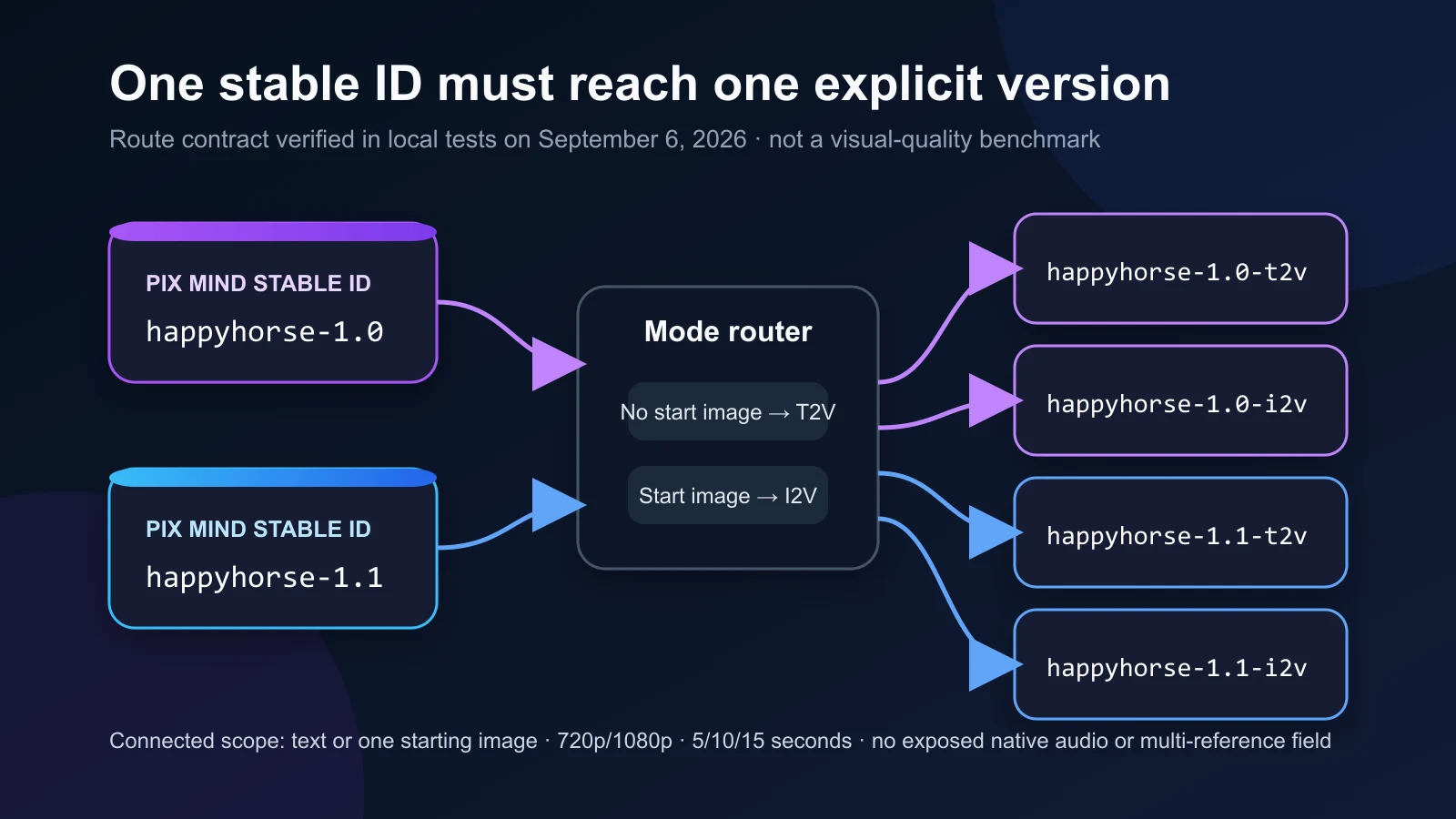
This deterministic editorial diagram documents the corrected local routing contract. It is not a production deployment receipt or evidence of output quality.
Upstream capability is not connected capability
Alibaba's upstream documentation describes a broader Happy Horse 1.1 family than the current connected route exposes. This is useful for understanding the model's potential, but it must not be copied directly into a product capability table.
Alibaba's current video generation and editing model guide lists Happy Horse 1.1 text-to-video, image-to-video, and reference-to-video variants. Its model tables document 480p, 720p, and 1080p output, 3 to 15-second duration, 24 fps, and audio at the upstream family level. Alibaba's reference-to-video API documentation also documents both 1.0 and 1.1 R2V variants, while the Happy Horse 1.1 R2V model page describes workflows with up to nine reference images. R2V existed in 1.0 upstream; 1.1 improved it rather than introducing it from nothing.
The connected interface checked for this article exposes only:
- Text-to-video or image-to-video with one starting image
- 720p or 1080p resolution
- 5, 10, or 15-second duration presets
- 16:9, 9:16, 1:1, 4:3, or 3:4 aspect ratio
- No documented audio control
- No documented reference-to-video or multi-reference input
This boundary matters for both product copy and client code. “The upstream model supports audio” is not equivalent to “this route returns audio.” Likewise, an upstream R2V model name does not make an array of reference images valid on a connected I2V endpoint.
The safest documentation pattern is to label every capability by scope: upstream documented, connected and exposed, or production verified. That three-level label prevents a roadmap feature from being mistaken for something a customer can call today.
Happy Horse 1.1 vs 1.0 API pricing
The current public model pages show different levels of price precision. The 1.1 page starts at $0.24 per second and does not publish a separate 1080p tier. The 1.0 model page rounds its tiers to $0.19 per second at 720p and $0.28 at 1080p; the detailed 1.0 documentation lists $0.176 and $0.256 respectively.
| Public price display checked 2026-09-06 | Happy Horse 1.1 | Happy Horse 1.0 | 10-second planning example |
|---|---|---|---|
| Starting tier | $0.24/sec | $0.19/sec rounded on the model page | $2.40 vs $1.90 using displayed rates |
| Resolution detail | No separate public 1080p tier shown | $0.28/sec at 1080p; detailed docs list $0.176/$0.256 for 720p/1080p | Use the accepted quote, not a reconstructed 1.1 tier |
The arithmetic is straightforward:
estimated API cost = quoted rate per second × requested duration
This is a planning formula, not a billing guarantee. Retries, validation failures, account-specific terms, promotions, or a later price update may affect the actual charge. Use the quote returned when the task is accepted as the final transaction-specific amount.
Do not convert Studio credits into dollars or combine them with these API rates. Studio consumption and API-platform dollar pricing are separate records with separate commercial contexts. If a budget sheet needs both, use two columns, label their source and retrieval date, and never infer one from the other.
Check the current 1.1 API model page immediately before submitting a batch. For upstream provider rates, consult Alibaba's Model Studio pricing page, but do not substitute provider pricing for the connected platform's accepted quote.
Which Happy Horse version should you choose?
Choose by verification state and workflow need, not by version recency alone. A production system benefits more from a correctly routed, observable model than from a newer label whose execution cannot be confirmed.
Choose 1.1 after production acceptance when
- You are starting a new integration and can wait for deployment verification.
- The higher 720p rate fits the budget.
- You want the current migration target and expect the connected route to expand later.
- Your observability can preserve requested model, accepted quote, provider task reference, output metadata, and deployment version.
Keep 1.0 temporarily when
- It is an existing production baseline with known output and cost behavior.
- A switch cannot be rolled back quickly.
- The 720p price difference matters at batch scale.
- The 1.1 production acceptance checks have not passed.
Do not switch for upstream-only features yet
Do not migrate solely to obtain audio, 480p, or multi-reference video on the current connected route. Alibaba documents those capabilities upstream, but the checked interface does not expose them. Wait for the relevant field, validation rules, price, and an end-to-end task to be documented and tested.
There is also no defensible visual winner in this article. A fair benchmark would require matched prompts and starting images, fixed duration, resolution, ratio, seed policy where available, repeated samples, blinded review criteria, and proof that each task executed on the named version. Those conditions were not met, so subjective claims such as “1.1 is more cinematic” or “1.0 has better motion” would be speculation.
A reproducible Happy Horse migration checklist
A safe migration has two gates: deployment correctness and output acceptance. Passing unit tests is necessary, but it is only the first gate.
1. Freeze the baseline
Record the current 1.0 request shape, duration, resolution, ratio, cost quote, status transitions, output metadata, timeout, and retry behavior. Keep a small set of rights-cleared prompts and starting images for regression testing.
2. Deploy the version-aware route
Confirm that the deployed service maps happyhorse-1.0 to upstream 1.0 and happyhorse-1.1 to upstream 1.1. Record the deployment identifier. Do not infer production behavior from a local test run.
3. Verify model discovery and validation
Check that the target account can discover happyhorse-1.1. Submit one valid T2V request and one valid single-image I2V request. Also submit a controlled invalid model ID and confirm that it fails rather than silently falling back.
4. Capture the accepted quote
Compare the returned rate and total with the dated public page. Stop the test if the quote exceeds the approved ceiling. Store API dollar amounts separately from Studio credits.
5. Prove upstream identity
Retain the provider task reference and any response field or server trace that identifies the upstream model. A request-body model label or internal database category is not enough if the routing layer can substitute a version.
6. Inspect delivery behavior
Verify duration, dimensions, aspect ratio, file integrity, and audio presence or absence. Run the same checks for both text and image input. Do not add unsupported upstream fields to this acceptance test.
7. Run a controlled content comparison
Only after identity is proven should you compare output. Use matched settings and several runs, then score prompt adherence, subject consistency, motion continuity, artifacts, and text rendering with a written rubric. Label the result as a limited sample, not a universal model ranking.
8. Canary and roll back
Route a small percentage of eligible jobs to 1.1, monitor failure rate, latency, cost, moderation outcomes, and output acceptance, then increase traffic gradually. Keep 1.0 available until the rollback window closes.
Commercial use and third-party rights
Free-account outputs are for personal, non-commercial use. Eligible outputs created while an active paid PixMind membership is in effect may be used commercially under the PixMind Terms, subject to the selected model or provider terms, your rights in prompts, uploads, reference assets, audio, likenesses, trademarks, applicable law, and third-party rights. Generation does not itself provide complete legal clearance. Check the current plan rules before client, advertising, publishing, or resale work.
Model output may also be subject to law, contract, platform policy, or rights that vary by jurisdiction and use case. Do not describe generated media as “commercially cleared” solely because a paid task completed. For a campaign, client delivery, resale, or regulated use, review the current terms and obtain legal advice appropriate to the project.
This wording should remain consistent across model pages, pricing pages, and articles. A concise reusable version is: “Commercial use is available for eligible outputs created during an active paid membership, subject to PixMind Terms, model/provider terms, and third-party rights.”
Frequently Asked Questions
Is Happy Horse 1.1 available on PixMind?
The public API page listed happyhorse-1.1 as Available on September 6, 2026. A local routing fix also passed its tests. However, the corrected route had not yet been deployed and verified with a paid production generation, so this article does not claim independent production execution.
Is Happy Horse 1.1 better than 1.0?
Alibaba documents a wider upstream 1.1 family, but this article does not rank visual quality. A valid comparison first needs proof that each task ran on the named upstream version, followed by controlled repeated samples and a disclosed evaluation rubric.
How much does Happy Horse 1.1 cost?
The public API model page starts at $0.24 per second and did not publish a separate 1080p rate during this review. The accepted task quote is final. API dollar prices must not be mixed with Studio credits.
Does the connected Happy Horse 1.1 route generate audio?
No audio control was exposed by the connected interface checked for this guide. Alibaba documents audio for upstream Happy Horse variants, but that does not prove audio is available through the connected route.
Can I use multiple reference images with Happy Horse 1.1?
Not through the checked connected route, which exposes one optional starting image. Alibaba documents an upstream 1.1 reference-to-video variant with multiple references, but that capability should remain labeled upstream-only until the product exposes and verifies it.
Can I use Happy Horse output commercially?
Do not assume that a generated output is automatically cleared for every commercial use. Confirm plan eligibility and current terms, then secure any necessary rights to source material, people, voices, music, brands, and other protected content.
Conclusion
Happy Horse 1.1 is the public Hub default and the logical migration destination, but its upstream execution is not yet independently verified in production. Its public route is listed as available, its API price starts at $0.24 per second, and the local version-aware release candidate passed its focused 9-test suite as well as a 21-test combined run that included those focused checks. The remaining work is operational: deploy the fix, confirm discovery, capture the accepted quote, prove upstream identity, verify delivered media, and canary traffic with a rollback path.
Until those checks pass, keep 1.0 as the known baseline and describe 1.1 with precise scope. Separate Alibaba's upstream family from connected features, and separate connected features from production verification. That discipline produces more reliable migrations and more accurate product documentation.
Next, run the acceptance checklist before changing production traffic.